

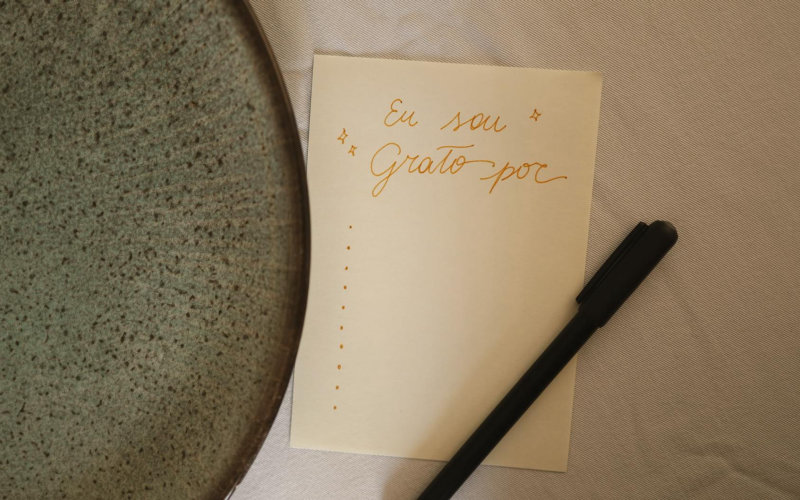

I’ll be honest. When my therapist first floated the gratitude practice idea back in 2019, I was the least receptive person in that room. I remember sitting there thinking, “Three good things. That’s the fix. For Mondays.” It felt like advice stitched onto a throw pillow — decorative, harmless, useless.
But I tried it anyway. Desperation is a powerful motivator. And something shifted. Not dramatically, not in any way I could point to immediately. More like a slow dimming of that relentless inner critic — the voice that grades everything and finds it wanting. Quieter. Still there, but quieter.
So if you’ve rolled your eyes at gratitude journaling (fair), this is for you. I want to show you a version that doesn’t feel like homework, doesn’t demand a personality transplant, and — genuinely — starts moving the needle on your mood within two weeks.
Why Your Brain Actually Needs This (Not Just Wants It)
Here’s the thing about your brain: it’s not broken, it’s just pessimistic by design. Neuroscientists call it negativity bias. You evolved to scan for threats, not appreciate sunsets. A 2005 study by Roy Baumeister at Florida State confirmed what most of us already feel — bad events carry roughly twice the psychological weight of equally good ones. You’re not a downer. You’re wired.
A daily gratitude practice is basically a manual override for that wiring. Robert Emmons and Michael McCullough ran a study in 2003 where participants wrote weekly gratitude lists and reported 25% higher life satisfaction than control groups. Twenty-five percent. That’s not a rounding error — that’s the distance between a week that grinds you down and one you can actually survive.
And crucially, this isn’t about pretending life is fine. You’re not lying to yourself. You’re retraining where your attention lands. Big difference.
The One Reason Most Gratitude Practices Fail
Generic. Full stop.
“Grateful for my family.” Sure. Meaningless. Your brain files that next to elevator music — technically registered, immediately forgotten. Martin Seligman’s 2005 Positive Psychology research at the University of Pennsylvania showed that specificity is what creates actual emotional resonance in these exercises.
So instead of “grateful for my family,” try something like: “grateful that my sister sent me a dumb meme at 11pm because she knew I was spiraling.” That one small detail — your brain actually shows up for that. You stop thinking about gratitude and start feeling it. And the feeling is the entire point.
The Two-Week Starter System (Exactly What to Do)
This is what I’d recommend. It’s also what I’ve watched stick for people — years of comments on this blog have been pretty instructive.
Week one: embarrassingly simple. Every morning, before you touch your phone, write down ONE specific thing you appreciated from the previous day. Not three. One. The low bar is intentional. A 2016 habit formation study in the European Journal of Social Psychology found that lower-effort habits hit automaticity faster than ambitious ones. You want this to feel like brushing your teeth — not like drafting a thesis.
Week two: add an evening piece. Before bed, find one moment from that day worth keeping. Not a lesson. Not growth. Just a moment — the first sip of coffee, a stranger holding the door, whatever. These small sensory anchors yank your brain out of abstract worry and into actual memory, which is where positive emotion actually lives.
You Don’t Need a Special Journal
Please stop waiting for the perfect leather journal. A sticky note works. Your notes app works. The back of a grocery receipt works. I used a 99-cent composition notebook for the first four months. Still worked.
What matters is articulating the thought in words — written or spoken — because that articulation is what moves gratitude from a fleeting feeling into a processed memory. Typing counts. Voice memos count. Telling someone at dinner counts.
And if you miss a day? Let it go. Skip the guilt spiral and pick it back up tomorrow morning. Perfectionism has killed far more habits than laziness ever has.
What “Changed Mood” Actually Looks Like
People want the before-and-after. The dramatic transformation. That’s not what you’ll get — and honestly, that’s fine.
What tends to happen around day 10 or 11 is quieter than that. You’re stuck in traffic, annoyed, and you also notice the song that just came on is one you love. Both things, at once. That dual awareness — holding the frustrating and the good in the same moment — is the real goal here. Not toxic positivity. Cognitive flexibility. There’s a difference.
Dr. Sonja Lyubomirsky at UC Riverside has spent twenty years studying happiness interventions. Her work keeps showing the same thing: the people who get the most out of gratitude practices treat it as an attentional exercise, not a mood bypass. They’re not trying to feel better. They’re practicing noticing differently.
Making It Stick Past Two Weeks
Two weeks builds momentum. But momentum needs tending.
Vary the format every few weeks — switch from writing to saying it out loud on your commute, or sketch a tiny symbol instead of words, or just change the time of day you do it. Your brain habituates faster than you’d expect. Once gratitude goes fully automatic, it loses some punch. (Think about how you stopped actually tasting your toothpaste sometime around year two of using the same brand.)
Also worth trying: gratitude directed at a specific person. Research from UC Berkeley’s Greater Good Science Center, published in 2020, found that writing gratitude letters — even ones you never send — produced more sustained emotional lift than general journaling. Pick one person per week. Write three sentences about something specific they’ve done or just been for you. Unsent is fine. The effect holds.
Bottom Line
Here’s what nobody really says out loud: gratitude doesn’t work because it makes you feel happy about your life. It works because it makes you feel present in your life. Happiness runs downstream from attention, and this whole practice is really just attention training wearing a warm-and-fuzzy disguise. The mood shift you feel in two weeks isn’t because anything changed out there. It’s because you stopped letting your brain auto-scroll past the good stuff on its way to the next problem.
Frequently Asked Questions
How long should my daily gratitude practice take each day?
Two to five minutes. Genuinely. Specificity matters far more than duration — one deeply felt observation beats a vague list of ten, every single time.
What if I genuinely can’t think of anything to be grateful for?
Go smaller than you think you need to. Warm tap water. No physical pain right now. The fact that you woke up. These aren’t cop-outs — they’re real starting points, and your brain will start building from there once you actually give it permission to look.
Can I do this without writing anything down?
You can, but writing or speaking it out loud makes it stickier. A 2021 study in Psychological Science found that verbal and written articulation of positive experiences significantly boosted how strongly those experiences were encoded in memory — compared to just thinking about them quietly.
Will this help with clinical anxiety or depression?
It can be a useful addition to professional treatment. But it’s not a replacement — not even close. If you’re working with a therapist on diagnosed anxiety or depression, bring this up as one tool in the kit. Not the whole kit.
Photo by Letícia Alvares on Pexels